Line by line
What this episode says, and why
Tap the 1 after a line to see its evidence card.
Chapter 1Intro
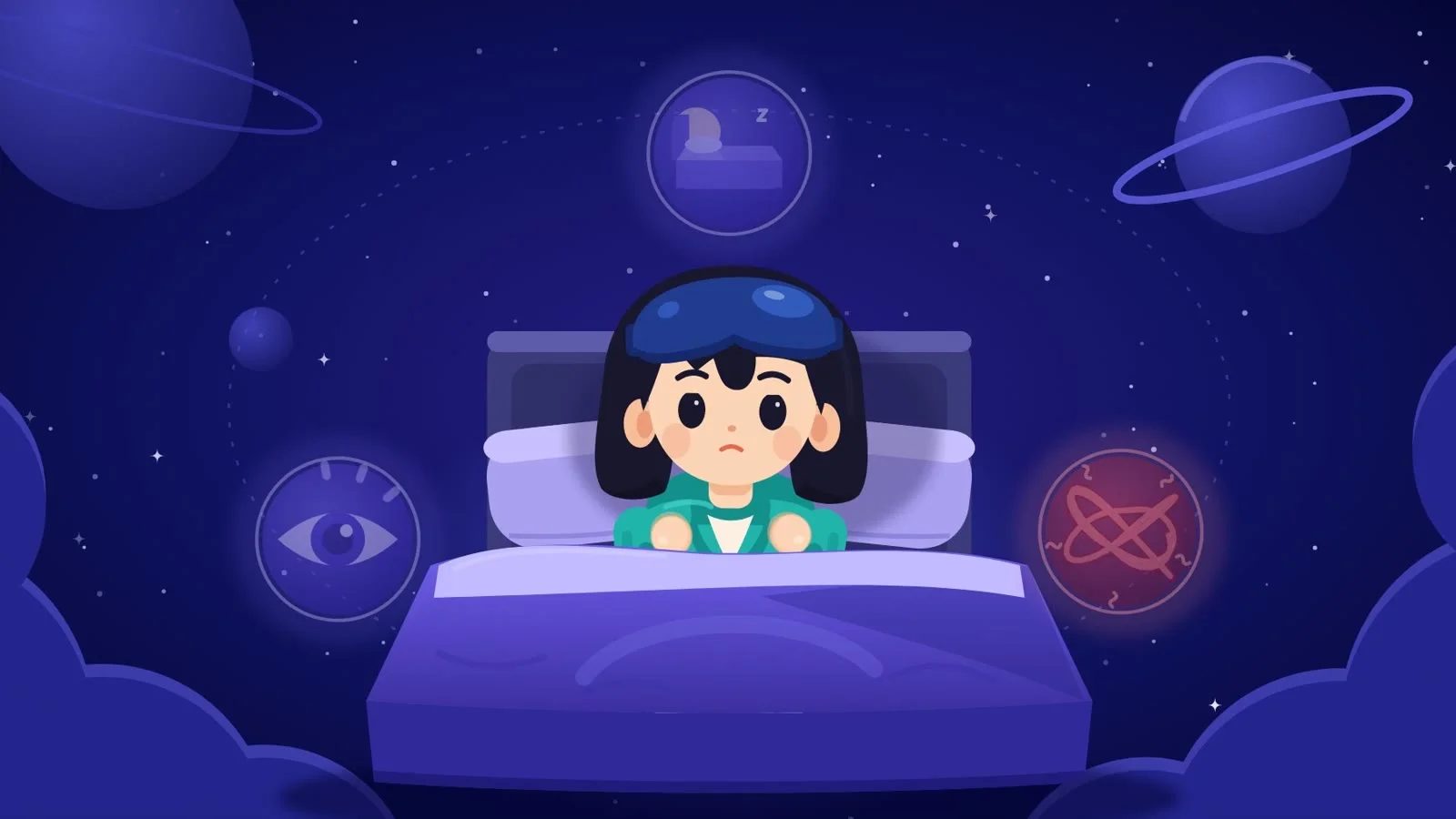
Two a.m. You've been lying there for an hour. You're exhausted, but your brain keeps getting more awake. You finally drift off… then the alarm goes, and it's like you never slept.
You might think you can't sleep because you're not relaxed enough. But whether you feel sleepy isn't really up to you. There's a machine in your brain, and three switches have to flip at the same time before you can fall asleep. And what flips those switches comes down to five things: light, temperature, stress, your evening habits, and what time you get up.
To make those five things clear, I took three bestselling sleep books, a top neuroscience podcast and the latest sleep medicine guidelines, and boiled them down into these eight minutes. This is Fundamentally, Sleep Series, episode one. Let's begin.
First, how do you get sleepy at all? Every minute you're awake, your brain is burning energy, and it leaves behind a kind of waste called adenosine. The longer you're awake, the more of it piles up.12
Adenosine sticks to your nerve cells and slows down the ones that keep you awake, like turning the volume of wakefulness down, one notch at a time. The more piles up, the sleepier you get. That's sleep pressure. Only once you're asleep does it slowly get cleared away.12
But pressure alone isn't enough. Your brain also has a body clock, and it decides when the sleep window opens. If the window isn't open, it doesn't matter how much pressure you've got. Sleep won't come easily.
And then there's a brake: how alert your body is. Stress, a body that's too warm, a brain that won't switch off, and the brake stays on.
So falling asleep takes three things at once: enough pressure, an open window, and the brake off. Everything in the next five factors is really about tuning these three.
Chapter 2Light
Factor one: light.
Besides the cells you see with, your eyes have a special kind of light-sensing cell. It doesn't help you see anything. It has one job: telling your brain whether it's day or night.3
That signal goes straight to a tiny region deep in your brain, the suprachiasmatic nucleus. That's your master clock. Every organ in your body sets its rhythm by it.3
But your body clock runs a little slow. On average, one full turn takes a bit more than twenty-four hours, about ten to twenty minutes longer than a day. If nothing resets it, it drifts a little later every day, and you get sleepy later and later. So it needs resetting every day, and the strongest reset signal is morning light.4
Once morning light hits your eyes, the clock is set. About fourteen to sixteen hours later, your brain starts releasing melatonin, and you naturally get sleepy. Morning light is basically setting an alarm for tonight's sleepiness.5
The catch: indoor light is way dimmer than you think. Normal indoor lighting is a few hundred lux. Outside on a cloudy day, it's several thousand. On a sunny day, up to a hundred thousand.6
But your eyes are great at fooling you. When a room is dim, they quietly turn up the brightness and tell you, hey, this is plenty bright. Your body clock doesn't fall for it.6
Flip it around: bright light at night makes your clock think the sun hasn't set yet. It pushes melatonin later, and you get sleepy later and later.7
As for scrolling in bed: blue light does matter, but the bigger problem is what you're watching. One video after another keeps your brain buzzing, and you can't put it down.8
So for light, just two things. Within an hour of getting up, spend some time outside: about ten minutes if it's sunny, twenty or thirty if it's cloudy. And in the evening, dim the lights. Low, warm lamps instead of the big ceiling light.57
Chapter 3Temperature
Factor two: temperature.
At night, your body clock deliberately turns your core temperature down a little. Here's how: as melatonin rises, the blood vessels in your hands and feet open up and carry heat out to the skin, where it escapes. That's why your hands and feet often get warm right before you feel sleepy.91011
And it works the other way too: help your body get rid of heat, and you'll get sleepy more easily. The part of your brain that senses temperature sits right next to the sleep switch. So when heat flows out, it reads that as: time for bed.1213
So, one to two hours before bed, take a warm bath, around forty degrees Celsius. That's about a hundred and four Fahrenheit: comfortable to soak in, not as hot as you can stand. Sounds backwards, but once you get out, heat pours off your skin and your core temperature actually drops faster. Pooled studies say you fall asleep about ten minutes sooner.14
Keep your bedroom cool. But shedding heat isn't the same as freezing. When your hands and feet go icy, your body thinks it's cold out, so it clamps those blood vessels shut to keep the heat in, and the vents close. So if your feet are cold, warm them up first.1516
So for temperature, remember three things. A warm bath one to two hours before bed. A cool bedroom. And if your feet are cold, wear socks to warm them up, then take them off once you're in bed.141516
Chapter 4Stress
Factor three: stress. And you can't talk about stress without one hormone: cortisol.
Lots of people think cortisol is the bad guy. Actually, it's your wake-up hormone. Every morning it surges to its highest point of the day to get you up, and by night it should drop to its lowest.
Cortisol and melatonin are like the two ends of a seesaw. In the morning, cortisol's high and melatonin's low. At night, it flips. When you can't sleep, it's often because at night, the seesaw never flipped.
Worry before bed puts your body into fight mode: your heart speeds up, your temperature rises, and cortisol climbs right along with them. The brake gets slammed down.
Worse, if you often lie in bed tossing and turning, your brain learns the wrong lesson: bed means awake, bed means anxious. So the moment you lie down, you're wide awake.
Here's another one that sounds wrong: the two hours before your usual bedtime are the hardest time of the whole day to fall asleep. Researchers call it the forbidden zone. So going to bed an hour early to catch up usually just means lying there, more stressed.
So how do you release the brake? One: before bed, spend five minutes writing down tomorrow's to-do list. In one experiment, people who wrote a to-do list fell asleep faster than people who wrote down what they'd already done.
Two: breathe out slowly. Make each breath out longer than the breath in, and your heart rate slows down with it.
Three: if you've been lying there for about twenty minutes and still can't sleep, get up. Go somewhere dim, do something boring, and come back when you're sleepy. Let your bed mean one thing only: sleep.
Chapter 5Evening habits
Factor four: evening habits.
Let's start with alcohol. Plenty of people think a drink helps them sleep. And alcohol does knock you out faster, but that's closer to being sedated than to natural sleep.17
Later in the night, once the alcohol's been processed, your body rebounds. Sleep gets lighter, you wake up more, and a big chunk of your REM sleep, the dreaming kind, gets cut. So after drinking, you can get enough hours and still wake up tired.17
Next, dinner. Eat too late or too much, and your body's still busy digesting, so your temperature can't come down.18
Exercise is good news: regular exercise clearly improves sleep. Working out in the evening is fine too. Just skip intense workouts in the last hour before bed.19
For that last hour, give yourself the same wind-down routine: dim the lights, wash up, read a book that won't get you worked up. Do it the same way every night, and your brain learns to treat it as the signal for sleep.20
So: no alcohol in the three hours before bed, finish dinner two to three hours before, and use the last hour to wind down.171819
Chapter 6Wake time
Factor five: what time you get up.
Your wake-up time sets two things at once. When you get up is when you first see morning light, so that's where your body clock resets. And when you get up is also when adenosine starts building.
Of those two, one decides when you've built up enough tiredness, and the other decides when your sleep window opens. Fix your wake-up time, and the two meet at the same time every night: the jar's just full, the window's just open, and you get sleepy right on schedule.
But what if you sleep in till eleven on Saturday? Adenosine starts building four hours late. By your usual bedtime, the jar isn't full yet. There's not enough pressure, so you lie in bed and just can't fall asleep.1
Lots of people get up early on weekdays and sleep till noon on weekends. That's like flying across time zones every weekend, then flying back on Monday morning. Researchers call it social jet lag.
So get up at the same time every day, weekends included. Your bedtime doesn't have to be that strict: when you're sleepy, go to bed.
Now let's put it all into one day. Get up at the same time, and get outside within an hour. Exercise during the day. Finish dinner two to three hours before bed, and no alcohol in the last three. Take a warm bath one to two hours before bed. In the last hour, dim the lights and write tomorrow's to-do list. Keep the bedroom cool, and go to bed when you're sleepy.
One last honest note: these tips help most people sleep better. But if you've had insomnia for more than three months, the most effective treatment is cognitive behavioral therapy for insomnia, CBT-I, so see a sleep clinic. And if you snore loudly and you're always sleepy during the day, get checked for sleep apnea.
This sleep plan is at the end of the video. Screenshot it and try it tonight. This is Fundamentally, see you next time.